
Expert report review
Spontaneous combustion fire: how does a reviewer check a report that blames oily rags?
A report that blames spontaneous combustion says that oil soaked into rags or towels heated itself until it ignited, with no outside ignition source. A reviewer checks whether the report names an oil that self-heats, shows how the material was piled or stored, fits the hours between use and ignition, puts the material at the origin and excludes the other sources in the room.
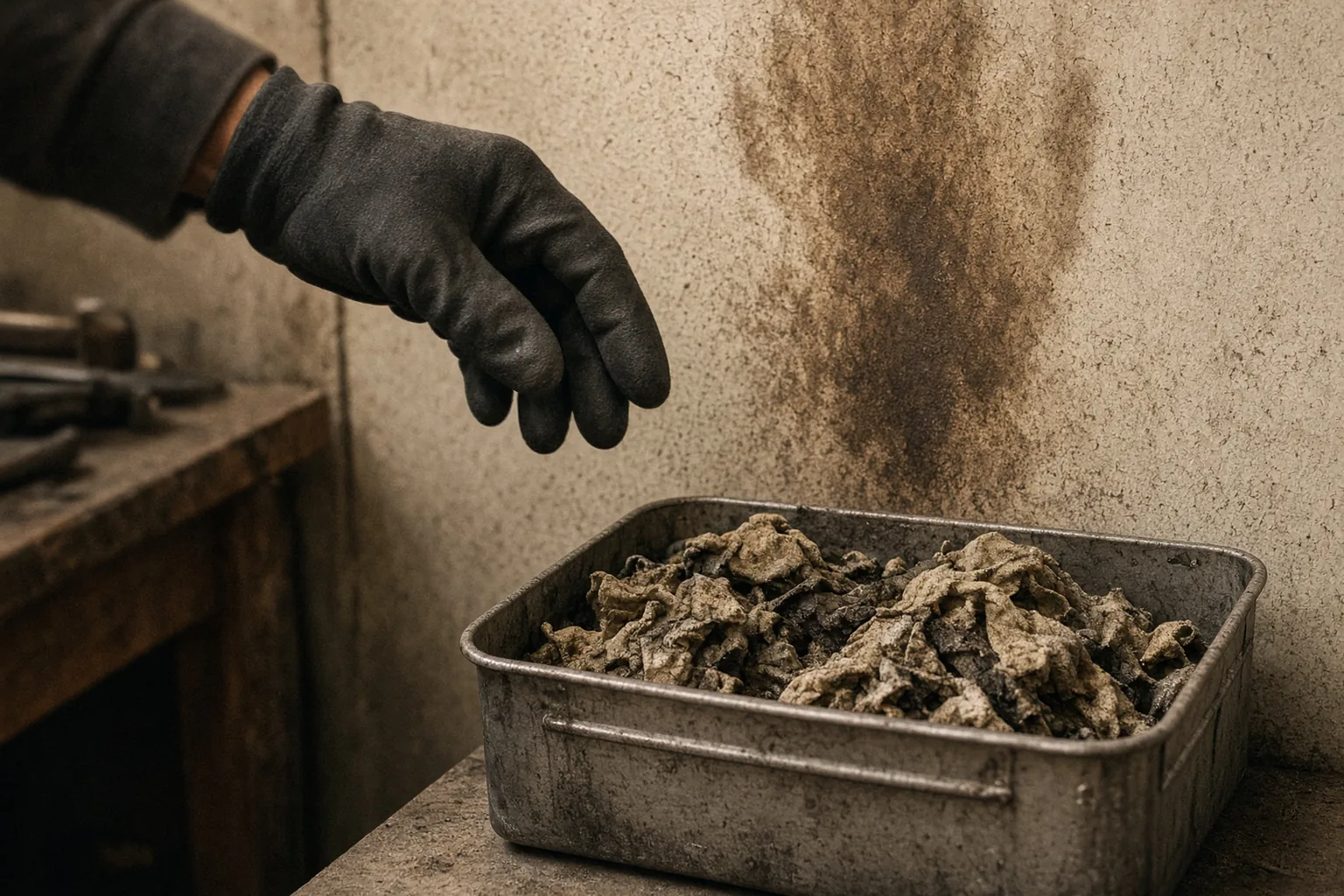
What does a spontaneous combustion report have to establish?
Five links: a material that self-heats, storage that let the heat build up, a timeline that fits, the material located at the origin, and the other ignition sources excluded. A gap in any link is a review point.
Spontaneous combustion differs from most fire causes because there is no ignition source to find. The heat comes from the material. A report that names it as the cause is therefore built mostly from circumstances: what was on the rags, where they were left, when, and what else in the area could have started the fire.
Each of those circumstances has its own evidence. The oil is identified from the product container, a receipt or the testimony of the person who used it. The storage comes from witnesses and from what remains of the container. The timeline comes from the time of use and the time of the alarm or the first sighting of smoke. The origin comes from fire patterns. The exclusion of other sources comes from the scene examination.
A reviewer lists the five links and writes next to each the evidence the report gives for it. A report that says only that rags were present in the area of origin and that the oil is known to self-heat has given evidence for two links out of five.
Which oils and materials self-heat?
Drying oils such as boiled linseed oil, and also cooking and massage oils. A 2012 New Zealand Fire Service bulletin lists linseed, fish and soya bean oil, peanut, corn, olive and canola oil, and eucalypt massage oil.
Heads Up bulletin No. 13, on spontaneous combustion with organic oils, was released on February 24, 2012, draws on New Zealand Fire Service fire investigation reports and is now posted on the website of Fire and Emergency New Zealand. It names three groups. Drying oils: boiled linseed, fish and soya bean. Cooking oils: peanut, corn, olive and canola. Massage oils: eucalypt.
The bulletin describes these oils as having "self heating properties" and ties the danger to oil spread thinly on porous material, which exposes a large surface of oil to air. Once the fabric ignites, it gives off enough heat to ignite nearby items. A single oily rag hung flat in open air and the same rag pressed into a bag with others are therefore different hazards.
For a review, the identity of the oil is the first fact to check. A wood stain with a drying oil base, a cooking shortening and a massage oil are different products with different labels and different defendants. A report that says only oily rags, without naming the product, leaves the reviewer unable to check the first link.
Under what conditions do rags or towels ignite, and how long does it take?
When oily cloth is piled, bagged or folded while hot, so the heat cannot escape. In the New Zealand cases ignition came between about 90 minutes and 8 hours after the material was left.
The New Zealand bulletin lists the risk conditions: rags smeared with oil and left in a small pile or bag; laundered towels dried, folded or stored while still hot; dryers stopped before the cool-down cycle ends; towels left in the drum or in a heap. It also notes that "Enzyme-based laundry powders and cold washes do not remove all oils and fats," so washed towels can still carry oil.
Its three case studies give times. In the first, rags stored in a plastic bag ignited about 7 to 8 hours after they were placed on a bench. In the second, towels left in a commercial dryer drum ignited about two hours after the dryer was stopped. In the third, towels folded hot from the dryer caught fire about 90 minutes later. The bulletin states that rags at room temperature "can ignite within hours" and reports a laboratory test in which oil-containing cotton towels self-heated to 575 °C before flaming. Between 2005 and 2010 the New Zealand fire service attended 59 incidents in commercial laundries and laundromats.
A report's timeline is checked against these facts. If the rags were used in the morning and the fire was reported the same evening, the interval falls within the range the bulletin describes. If the report places the use weeks before the fire with no change in storage, the reviewer asks what started the heating at that moment.
Can a court accept spontaneous combustion without a found ignition source?
Yes. In Penwell v. Rust-Oleum (W.D. Wis. 2006) the court found a reasonable inference that stain rags ignited by spontaneous combustion, given the homeowner's testimony that no ignition source was near the waste basket.
On December 31, 2005, Betty Penwell bought a one-quart can of Varathane wood stain and applied it to woodwork in her home that day. She wiped the woodwork with cotton rags, gathered the stain-soaked rags and put them in a plastic waste basket. The rags spontaneously combusted, and the fire damaged the house. She testified that the basket was in a hallway and that she saw no ignition source nearby.
The Penwells sued Rust-Oleum Corp. for products liability and breach of warranty, and the case was removed to federal court. The parties agreed that every claim depended on showing that the label violated the Federal Hazardous Substances Act, which preempts differing state warning rules. In an order of December 22, 2006, Judge John C. Shabaz denied summary judgment.
On causation the court found, on Penwell's testimony about the basket, that "a reasonable inference is that the fire started by spontaneous combustion." On the label, it found that the front panel warning "combustible" satisfied the statute, but that whether the back-label warning, printed in small white letters on glossy black, was conspicuous was a question of fact. For a reviewer the case shows what the defense would have had to attack: the testimony that nothing else in the hallway could ignite the rags.
What happened when the expert could not support the warning opinion with data?
In Liberty Mutual v. CFC (D. Minn. 2009) the cause was conceded, but the insurer's warnings expert was excluded. His sources showed that the risk was known but gave no probability, and the court found too great an analytical gap.
Craig Kroonblawd ran a business selling fried food at festivals and cleaned his fryers with terrycloth towels. The fryer oil was Creamy Shortening, which CFC, Inc. sold in five-gallon containers, a blend of soybean oil and partially hydrogenated soybean oil. After a festival in Nebraska he washed the towels at his home in Minnesota and had them dried. A friend later found two smoldering piles on an ironing board. The smoke damage came to $213,248.56, and the insurer, Liberty Mutual, sued CFC for failing to warn about spontaneous combustion of towels contaminated with the shortening.
For the motion CFC conceded that spontaneous combustion caused the fire and that oil-soaked cloth towels can ignite that way. The dispute moved to the warning. Liberty's expert, George Karosas, did no testing and relied on fire treatises, NFPA statistics, a 1996 SDA study and a 1992 CPSC release. Judge Joan N. Ericksen found that the sources showed the risk was known but gave no probability, and that the NFPA data did not identify residential fires, the type of oil or the origin of the fire.
On October 23, 2009 the court excluded Karosas as offering an ipse dixit opinion with "too great an analytical gap" between the data and the conclusion. It held that Liberty had not shown that spontaneous combustion after laundering was reasonably foreseeable and dismissed the complaint with prejudice. A conceded cause did not carry the claim: the expert still had to connect the general hazard to this product, this use and this kind of fire.
Can an investigator reach spontaneous combustion by eliminating other causes?
Courts have accepted elimination of ignition sources under NFPA 921 when the investigator could not test the hypothesis physically. The reviewer then checks which sources were eliminated and on what data.
In Travelers Casualty Insurance Co. of America v. Volunteers of America Kentucky, Inc., decided August 21, 2012, Judge Karen K. Caldwell of the Eastern District of Kentucky addressed elimination in a fire at the Brookview Apartments in Lexington. All parties agreed that NFPA 921 was the appropriate method. The court held that the "inability to physically test a hypothesis" does not disqualify an expert who eliminated the other ignition sources under section 18.2.1 of the guide, and that "Experts can base opinions on direct and circumstantial evidence."
A spontaneous combustion opinion usually takes that route, because the rags burn away and the heating leaves no artifact of its own. The elimination then carries the weight of the opinion. The reviewer lists every potential ignition source in the area of origin: outlets, cords and appliances, lighting, heating equipment, smoking materials, a dryer's own heater and controls in a laundry fire. Next to each source the reviewer writes what the report says about it: examined and excluded on stated data, mentioned without data, or not mentioned.
The Brookview opinion also allowed experts who disagreed on the origin to go before the jury, holding that the disputes went to weight. A spontaneous combustion opinion that survives a motion can still be taken apart at trial if the elimination left a source unexamined.
What does a reviewer check in a report that blames spontaneous combustion?
The oil and its source, the quantity and storage of the material, the timeline, the material's location against the fire patterns, residue evidence, the ignition sources eliminated and any self-heating testing relied on.
The reviewer starts with the product: name, container, label, who used it and on what job. Then the material: rags, towels or mop heads, how many, whether they were washed, and how they were stored, with the source of each fact. A statement that the towels were folded hot from the dryer needs a witness or a record behind it.
Next the timeline: when the oil was applied or the towels came out of the dryer, when smoke was first seen, when the alarm or the call came in. The interval is compared with the range the evidence supports. Then the location: the report has to put the pile, bag or basket inside the area of origin established from fire patterns, and the origin must not have been chosen because the rags were there.
Last come the residue and the eliminations. Laundered towels can still show oil staining, which is physical evidence of the oil. Each potential ignition source in the area of origin needs its own line in the report. If the report relies on self-heating tests or literature, the reviewer checks whether the tested oil, cloth and quantity match the case. In Liberty Mutual the court faulted data that did not identify residential fires or the type of oil.
What does IAE do when the opposing report blames spontaneous combustion?
IAE prepares reviews of the opposing investigator's report for subrogation, product liability, arson defense and coverage disputes in US courts, and expert reports on the client's questions. Up to 5 business days.
The review lists each hypothesis the opposing investigator considered, checks what data excluded the others and which NFPA 921 edition was applied, and traces every artifact to its examination. In a spontaneous combustion case the client sends the opposing report with its exhibits, the scene photographs, information on the product and the material blamed, witness statements on use and storage, the alarm or call records, and states whether the scene and the removed artifacts still exist.
The secretariat confirms receipt the same day. Within one business day IAE confirms the format, the cost, the deadline and the specialist from its registry, and the client approves the candidate and the CV before work starts. The signed review is issued within up to 5 business days once the format and cost are confirmed; cases with tight deadlines have a 48-hour rush.
Every specialist is a member of the public IAE registry and passed the council's attestation under the published Criteria Matrix; the Member ID or QR code in the document opens the specialist's record. The specialist confirms in the document that he or she has no interest in the outcome. Materials are not passed to third parties without the client's consent. A review is evidence the court weighs with the other materials; neither IAE nor the reviewer guarantees the outcome, and IAE is not a law firm.
Sources
- Fire and Emergency New Zealand, Heads Up No. 13, Spontaneous Combustion with Organic Oils (Feb. 24, 2012)
- Penwell v. Rust-Oleum Corp., No. 06-C-337-S (W.D. Wis. Dec. 22, 2006)
- Liberty Mutual Insurance Co. v. CFC, Inc., No. 08-859 (JNE/SRN), Document 33 (D. Minn. Oct. 23, 2009) (Justia)
- Travelers Casualty Insurance Co. of America v. Volunteers of America Kentucky, Inc., No. 5:10-301-KKC, Document 98 (E.D. Ky. Aug. 21, 2012) (Justia)
Read also
All articles
Clothes dryer fire: how does a reviewer check a report that blames lint, the owner or the dryer's design?
In the dryer fire litigation described below, the reports ended in one of two sentences: the owner let lint build up, or the dryer was built so that Sergei Voronin
Space heater fire: how does a reviewer check a report that blames the heater?
Portable heaters start about 1,100 residential building fires a year in the United States, and in the court cases below the dispute ran betweenSergei Voronin
Unattended cooking fire: how does a reviewer check a report that blames the stove?
Cooking causes about half of all residential building fires in the United States, and in the kitchen fire cases discussed below the dispute ranSergei VoroninExpert report review
Ready to discuss your case?
Send the materials: the secretariat will confirm the format, cost, deadline and the specialist within one business day.
