
Expert report review
Thermal imaging in the opposing construction expert's report: what does a reviewer check?
A thermal image records surface temperature, not the defect behind it. The ASTM practice for thermographic inspection of insulation calls itself qualitative and states that proof of missing insulation requires independent validation, and the practice for wet roof insulation states that it does not find the cause of moisture or its point of entry. A reviewer reads the opposing report against those limits and against the conditions, images and data behind each anomaly.
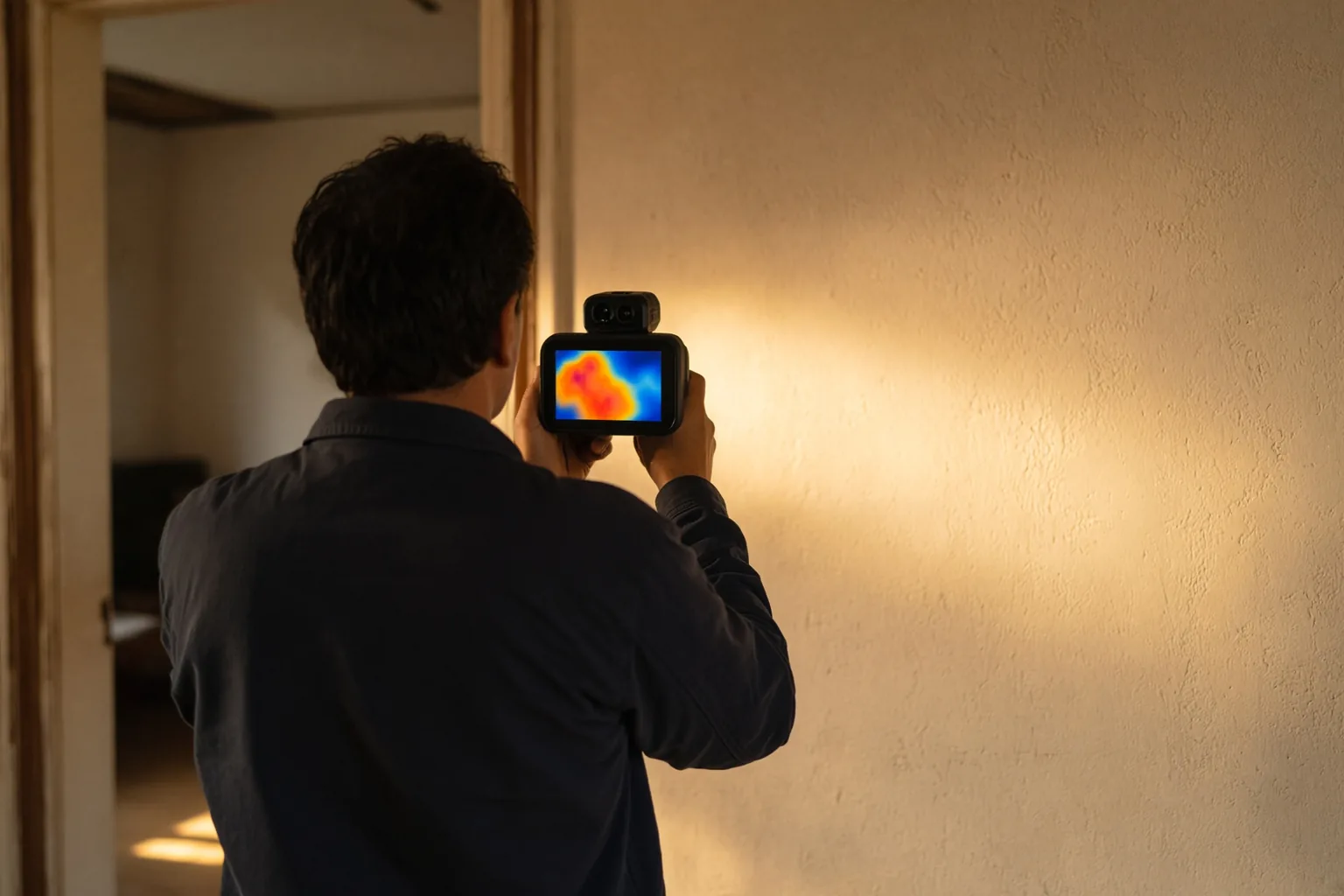
What can a thermal image show, and what can it not show?
It shows differences in surface temperature. ASTM C1060-23 describes qualitative thermal inspections and says proof of missing insulation requires independent validation; ASTM C1153-23 does not determine the cause of moisture or its point of entry.
ASTM C1060-23, Standard Practice for Thermographic Inspection of Insulation Installations in Envelope Cavities of Frame Buildings, last updated March 16, 2023, describes itself in section 1.1 as "a guide to the proper use of infrared imaging systems for conducting qualitative thermal inspections." Section 1.2 states that the practice "offers reliable means for detecting suspected missing insulation," and adds: "Proof of missing insulation or a malfunctioning envelope requires independent validation."
ASTM C1153-23, Standard Practice for Location of Wet Insulation in Roofing Systems Using Infrared Imaging, last updated October 16, 2023, covers "techniques that employ infrared imaging at night to determine the location of wet insulation in roofing systems." Section 4.3 states that it "does not provide methods to determine the cause of moisture or its point of entry" and does not address the suitability of any roofing system to function as waterproofing.
These limits set the frame for the review. A report that says a wall has "no insulation" or that a roof "leaks at the parapet" on the strength of thermal images alone states more than its own standard claims for the method. The reviewer marks each such sentence and looks for the separate evidence that would support it.
Which standard did the expert follow, and does it fit the building?
The reviewer checks which practice the report names and whether its scope covers the construction and the question. ASTM C1060 is limited to frame construction and emphasizes missing insulation; ASTM C1153 covers insulation above a roof deck.
Section 1.3 of ASTM C1060 states that the practice is "limited to frame construction," wood- or metal-framed walls, ceilings, roofs and floors. Section 5.1 places "the emphasis in this practice" on determining whether insulation is missing, and adds that interpreting other thermal anomalies may require procedures and techniques the practice does not present. A report that applies C1060 to a masonry or concrete wall, or uses it to diagnose air leakage or moisture, goes beyond the practice it cites.
ASTM C1153 covers insulation "above the deck in contact with the waterproofing," with ground-based and aerial inspections, at night. Section 4.1 describes it as setting "minimum necessary elements and conditions to obtain an accurate determination of the location of wet insulation." A daytime scan of a ballasted roof, or of a roof without insulation above the deck, needs its own justification.
Rule 702(c) asks whether the testimony "is the product of reliable principles and methods," and Rule 702(d) whether the principles and methods were reliably applied to the facts of the case. A standard outside its scope is a gap on both points. The 2000 committee note asks whether the expert employed "the same level of intellectual rigor" as in the practice of the field.
Were the conditions right for the scan?
The report should record the indoor and outdoor temperatures, wind, sun and precipitation before and during the scan, and the equipment settings. Both ASTM practices address environmental conditions and equipment criteria such as the minimum resolvable temperature difference.
ASTM C1060, section 1.4, describes the instrumentation and calibration "required under a variety of environmental conditions" for inspections from inside and outside the structure. ASTM C1153 addresses infrared equipment criteria, including the "minimum resolvable temperature difference" (1.2), and the "meteorological conditions under which infrared inspections shall be performed" (1.3). It also addresses the effect of roof construction, material differences and roof conditions on the results (1.4).
The reviewer builds a table from the report: date and time of each image, indoor and outdoor temperatures, wind, cloud cover and sun exposure in the hours before the scan, rain or dew, and the camera model, its calibration and the emissivity setting. Each blank in the table is a question. A scan without a recorded temperature difference across the envelope leaves the reader unable to tell whether a pattern is a defect or the normal state of the wall that day.
Rule 26(a)(2)(B)(ii) requires the report to contain "the facts or data considered by the witness in forming them." Weather readings, camera settings and the time of each image are facts the thermographer considered, and the 2010 committee note reads the phrase broadly to reach "any material considered by the expert, from whatever source, that contains factual ingredients."
Did the expert confirm the thermal anomalies by other means?
The reviewer looks for opened cavities, core samples, moisture readings or in-situ measurements at the anomalies. ASTM C1060 requires independent validation for proof, and ASTM C1153 covers verification of infrared data by invasive test methods.
Section 1.2 of ASTM C1060 names the validation techniques it leaves outside its own scope: "Validation techniques, such as visual inspection or in-situ R-value measurement, are beyond the scope of this practice." Section 1.6 of ASTM C1153 covers the "verification of infrared data using invasive test methods." Both documents treat the image as the first step.
The reviewer counts the anomalies in the report and the anomalies that were opened, cored or measured. If the expert opened three cavities and extrapolated the result to a hundred, the review asks how those three were chosen and whether the image pattern at the other locations matches the pattern at the opened ones. The review of extrapolation from a sample is its own question, and the report has to answer it.
Rule 703 lets an expert rely on facts or data that experts in the field "would reasonably rely on." A thermographer who relies on images alone for a conclusion that his own standard says needs validation has to explain why that reliance is reasonable in this case.
Does the report name a cause on the strength of a cold spot alone?
A cold or warm area can come from missing insulation, air leakage, moisture, thermal bridging or glare on a glossy surface. The reviewer checks whether the report rules out the other explanations before naming one.
ASTM C1153 states that it does not provide methods to determine the cause of moisture or its point of entry. ASTM C1060 says that interpreting anomalies other than missing insulation may require procedures and techniques it does not present. A report that assigns a cause to an anomaly is therefore making a second opinion beyond the scan, and that opinion needs its own basis.
The 2000 committee note to Rule 702 asks whether the expert "has adequately accounted for obvious alternative explanations." For a thermal anomaly the alternatives are concrete: a framing member or a metal tie, air moving through a gap, wet material, a heat source inside the room, glare from the sun or the sky on a glossy surface. The reviewer lists them and checks which the report addressed.
General Electric Co. v. Joiner, 522 U.S. 136 (1997), held that a court may conclude that "there is simply too great an analytical gap between the data and the opinion proffered." In a thermography report the gap can sit between a colored image and a sentence about workmanship. The review names the missing link: the opened cavity, the moisture reading or the air pressure test that was not done.
Which images and data should the other side produce?
Every image taken, in native radiometric form if the camera stores it, with the visible-light photograph of the same area, the settings, the time stamps and a plan showing where each image was taken.
Rule 26(a)(2)(B)(iii) requires "any exhibits that will be used to summarize or support" the opinions. A thermal image pasted into a report as a picture fixes one color scale and one temperature span chosen by the author. A file that keeps the temperature data lets the reviewer change the span, read point temperatures and compare areas.
Rule 34(a)(1)(A) reaches "any designated documents or electronically stored information," and Rule 34(b)(1)(C) lets the requesting party specify "the form or forms in which electronically stored information is to be produced." The request names the native image files, the software and version used to analyze them, the field notes and the weather data. The written response is due within 30 days after service under Rule 34(b)(2)(A).
The 2010 committee note states that protections for drafts and attorney communications do not exempt "the expert's testing of material involved in litigation" from discovery. Images that the thermographer took and did not use are part of that testing.
Is the thermographer qualified for the opinion given?
Rule 702 asks about qualification for each opinion. A thermographer qualified to take and read images is not by that fact qualified to state the cause of a defect or the cost of its repair.
ASTM C1153 lists "operator qualifications, and operating practices" among the subjects it covers (1.5). The report should state the thermographer's training and certification and the standard under which the images were taken. Rule 26(a)(2)(B)(iv) requires the witness's qualifications, including publications from the previous 10 years, and Rule 26(a)(2)(B)(v) the cases with testimony in the previous 4 years.
A thermography report may carry three opinions: that the images show anomalies, that the anomalies mean a defect, and that the defect costs a given sum to fix. The reviewer checks the expert's background against each one. Rule 702(a) asks whether the expert's specialized knowledge will help the trier of fact on the question each opinion answers.
What should the thermographer be asked at deposition?
Which standard and which edition, which conditions were recorded, which camera and settings, which anomalies were validated and how, which alternative causes were ruled out, and which images were left out of the report.
Rule 26(b)(4)(A) permits the deposition of an expert who must give a report only after the report is provided. Rule 30(d)(1) limits a deposition to "1 day of 7 hours" unless the parties stipulate or the court orders otherwise. The review supplies the order: standard and scope, conditions, equipment, validation, cause, then the remaining opinions.
Rule 705 lets an expert state an opinion without first testifying to the underlying facts or data, "but the expert may be required to disclose those facts or data on cross-examination." The questioner asks the thermographer to show, image by image, the temperature difference read at each anomaly and the reference area it was compared with.
How does the review of a thermal survey reach the court?
Through a rebuttal report due within 30 days after the other side's disclosure, deposition and trial questions, and a Rule 702 motion. The court decides whether the opinions are admitted, limited or left to cross-examination.
Rule 26(a)(2)(D)(ii) gives 30 days after the other party's disclosure for evidence "intended solely to contradict or rebut evidence on the same subject matter," unless a stipulation or court order sets other dates. A rebuttal on a thermal survey answers the same subject: what the images can and cannot support under the standards the survey invoked.
Rule 702 as amended on December 1, 2023 admits expert testimony only if the proponent establishes that "it is more likely than not" that the testimony "is based on sufficient facts or data" and "is the product of reliable principles and methods." The 2023 committee note adds that "each expert opinion must stay within the bounds of what can be concluded from a reliable application of the expert's basis and methodology." A conclusion about cause drawn from images that the cited standard calls qualitative is the kind of opinion that note addresses.
What does IAE do when the other side relies on a thermal survey?
An IAE engineer reviews the opposing construction expert's report for a US case, tests each opinion against the data behind it and writes a rebuttal report. Delivery in up to 5 business days after format and cost are confirmed.
The IAE review of the opposing construction expert's report is for attorneys facing the other side's expert on a leak, defective work or a repair estimate. The reviewer tests each opinion against the data behind it and writes a rebuttal report, due within 30 days after the opposing disclosure unless the court sets other dates. The documents offered are a review of the opposing expert report, a rebuttal expert report and deposition questions.
The client sends the opposing report and the case materials and describes what to check. The secretariat confirms receipt the same day, and within one business day IAE confirms the format, the cost, the deadline and the specialist from its registry. The client approves the candidate and the CV before work starts. The signed PDF is issued in up to 5 business days after the format and cost are confirmed, and a 48-hour rush is available for tight deadlines.
Specialists are members of the public IAE registry and passed the council's attestation under the published Criteria Matrix; the Member ID or QR code in the document opens the specialist's record. The specialist confirms in the document that he or she has no interest in the outcome, and materials are not passed to third parties without the client's consent. A review is evidence the court weighs with the other materials; neither IAE nor the reviewer guarantees the outcome, and IAE is not a law firm.
Sources
- ASTM C1060-23, Standard Practice for Thermographic Inspection of Insulation Installations in Envelope Cavities of Frame Buildings (ASTM, scope page)
- ASTM C1153-23, Standard Practice for Location of Wet Insulation in Roofing Systems Using Infrared Imaging (ASTM, scope page)
- Federal Rules of Evidence, Rule 702, Testimony by Expert Witnesses, with committee notes (LII)
- Federal Rules of Evidence, Rule 703, Bases of an Expert's Opinion Testimony (LII)
- Federal Rules of Evidence, Rule 705 (LII)
- General Electric Co. v. Joiner, 522 U.S. 136 (1997), full text of the opinion (LSU Law Center copy)
- Federal Rules of Civil Procedure, Rule 26, with committee notes (LII)
- Federal Rules of Civil Procedure, Rule 30, Depositions by Oral Examination (LII)
- Federal Rules of Civil Procedure, Rule 34 (LII)
- Federal Rules of Evidence, Rule 702, amendment history (Apr. 24, 2023, eff. Dec. 1, 2023), Office of the Law Revision Counsel
Read also
All articles
Sinkhole claim denied in Florida: how does a reviewer test the insurer's engineering report?
When a Florida insurer denies a sinkhole claim after testing, the denial rests on the report of the engineer or geologist it hired. Sections 627.706 Sergei Voronin
Cast iron pipe claim: what does a reviewer check in the opposing plumbing or engineering expert's report?
In a cast iron pipe dispute the expert's words about cause and duration decide coverage. In State Farm Florida Insurance Co. v. Feltes (Fla. 6th DCASergei Voronin
Window leak expert report: what does a reviewer check in the opposing water test?
A window leak report rests on a water test, and the test decides whether the opinion survives. In 2016 a federal court excluded all window-testingSergei VoroninExpert report review
Ready to discuss your case?
Send the materials: the secretariat will confirm the format, cost, deadline and the specialist within one business day.
