
 A new approach to the data analyst profession: end-to-end ownership of analytical data flows
 Aleksandr Vasilchenko
Engineering and technologyOnline publication · September 22, 2026
Эволюция железнодорожной симуляции: от виртуальной кабины к интеллектуальной системе управления компетенциями

Abstract
The development of railway simulator technologies is gradually changing the role of the simulator in professional personnel training. Whereas the main indicator of progress has traditionally been the degree of realism of the simulated cab and of rolling stock behavior, modern systems are increasingly becoming sources of data on trainee actions and components of a digital learning environment. This article examines promising directions of this transformation: the use of training data generated by simulator complexes, adaptive training scenarios, artificial intelligence, digital twins, distributed digital platforms, and the integration of training outcomes with safety management tasks.
A conceptual architecture of a prospective intelligent simulation system is proposed, in which real-world operational data are used to refine the digital model and to generate scenarios, training results are used for objective competency assessment, and accumulated data are used to identify risk factors and set training priorities. The main focus is on the transition from fixed to adaptive training and from the analysis of individual training session outcomes to systematic data analysis. It is shown that the further development of simulation is associated not only with increased visual realism but, above all, with the expansion of analytical functions and the establishment of continuous feedback between operations, training, and safety.
Russian abstract
Развитие железнодорожных тренажёрных технологий постепенно меняет роль тренажёра в профессиональной подготовке персонала. Если традиционно главным показателем прогресса считалась степень реалистичности воспроизведения кабины и поведения подвижного состава, то современные системы всё в большей мере становятся источниками данных о действиях обучаемых и компонентами цифровой обучающей среды. В статье рассматриваются перспективные направления этой трансформации: использование обучающих данных, формируемых тренажёрными комплексами, адаптивные сценарии подготовки, искусственный интеллект, цифровые двойники, распределённые цифровые платформы и интеграция результатов обучения с задачами управления безопасностью.
Предложена концептуальная архитектура перспективной интеллектуальной системы симуляции, в которой данные реальной эксплуатации используются для уточнения цифровой модели и генерации сценариев, результаты обучения - для объективной оценки компетенций, а накопленные данные - для выявления факторов риска и определения приоритетов подготовки. Основное внимание уделено переходу от фиксированного обучения к адаптивному и от анализа результатов отдельных тренировок к системному анализу данных. Показано, что дальнейшее развитие симуляции связано не только с ростом визуальной реалистичности, но прежде всего с расширением аналитических функций и формированием непрерывной обратной связи между эксплуатацией, обучением и безопасностью.
Keywords
Railway safety depends to a large extent on the ability of personnel to act correctly under operational conditions, time constraints, changing external conditions, and abnormal situations. Simulator technologies make it possible to create a controlled environment in which such situations can be reproduced repeatedly without risk to traffic, infrastructure, or personnel. In modern training systems, simulators are used for initial training, for maintaining professional skills, for assessing knowledge and actions, and for practicing complex and emergency scenarios.
However, the development of simulator technologies is gradually changing the very formulation of the problem. The simulator is ceasing to be merely a means of reproducing the workstation. A modern digital environment can record the trainee's decisions, sequence of actions, errors, reaction times, and scenario outcomes. As such data accumulate, it becomes possible to analyze not a single training session but stable patterns of professional behavior.
This raises a new question: how can simulator training data be used to improve the training system itself and, in the longer term, to identify risk factors earlier? In the proposed approach, the next stage of development is viewed as a transition from static simulation to an intelligent system that combines digital modeling, analytics, adaptive scenarios, and competency management.
The purpose of this article is to develop a conceptual view of a prospective architecture for railway simulation focused on the use of data and intelligent analytics. The article concentrates on changes in the functional architecture of the simulator environment and on its possible links with competency management and safety management processes.
Historically, the development of simulators has been closely linked to increasing realism: the reproduction of controls, the visual environment, motion dynamics, and the behavior of technical systems. Such realism remains an important prerequisite for developing practical skills; however, on its own it does not determine the further value of simulator complexes.
The current trend is a successive expansion of functions: from reproducing the workstation to modeling technical processes, then to scenario modeling, recording human actions, and analytical processing of results (Table 1). Thus, the simulator is gradually turning from a stand-alone technical device into a digital training environment.
| Stage | Direction | Object / focus | Main functions | Result / purpose |
|---|---|---|---|---|
| 1 | Imitation | Workstation | Reproduction of the appearance of the cab and controls Achieving basic realism | "Replicate reality" |
| 2 | Modeling | Technical system | Reproduction of the behavior of the object and processes Integration with infrastructure models | "Reproduce the system" |
| 3 | Scenario | Operational situation | Modeling of events that require decisions and actions Training under normal, complicated and emergency conditions Modeling of weather, malfunctions, obstacles and non-standard situations | "Teach to act" |
| 4 | Data | Human behavior | Recording of task performance parameters Assessment of reaction time Analysis of actions and errors Evaluation of results Objective assessment and analysis | "Measure and understand" |
| 5 | Intelligent system | Training Analysis Forecasting | Use of data to adapt training Personalized training Adaptive scenarios Risk identification Forecasting of potential risks Integration with operational data | "Train and anticipate" |
This transition changes the criterion for the development of the system. The question is no longer only how accurately the simulator reproduces the locomotive cab, but what data it is able to capture, how these data should be analyzed, and how the results of the analysis can be used to modify subsequent training.
Each training run generates a data set on human interaction with the simulated system. Depending on the architecture of the simulator complex, the following may be recorded: the sequence of actions, the decisions made, errors, reaction times, procedure execution parameters, scenario outcomes, and progress dynamics.
At the individual level, these data make it possible to assess specific skills. At the group or organizational level, the accumulated data can be used to identify problem areas: which procedures are most often performed incorrectly, which scenarios cause the greatest difficulty, which skills require additional training, and how training effectiveness changes over time (Figure 1).
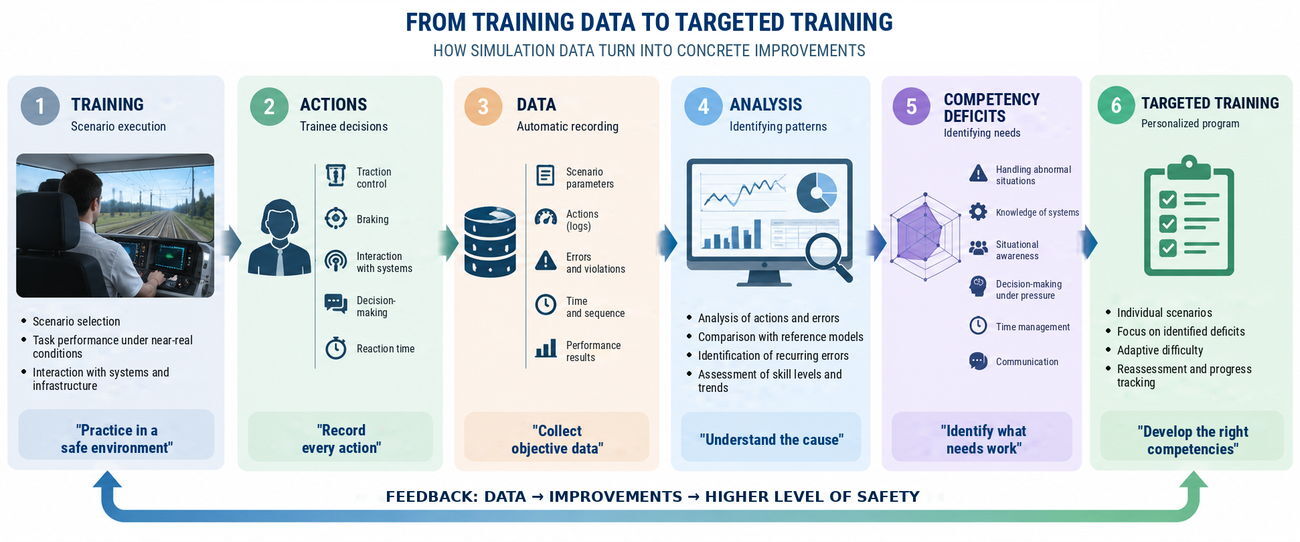
In this case, the data from training runs become not only the basis for grading but also a source of information for improving the training process. A shift occurs from training data to safety intelligence: the accumulated information can be used to set training priorities and to search for systemic problems.
At the same time, this approach requires further validation. An association between errors made on a simulator and real operational risks does not always imply a direct causal relationship. Therefore, further research should determine which indicators of behavior on a simulator most accurately reflect actual professional risks.
A traditional scenario usually has a predefined structure: the scenario is launched, the trainee performs actions, and then the system or the instructor evaluates the result. This model is effective for repeated practice of standard procedures, but it offers limited opportunities for individualizing training.
The next stage of development is adaptive scenarios, in which the sequence of events can change depending on the trainee's actions. For example, consistently correct performance may increase task difficulty, difficulties may trigger additional practice, and an error may alter the course of the situation or introduce an additional factor (Figure 2).
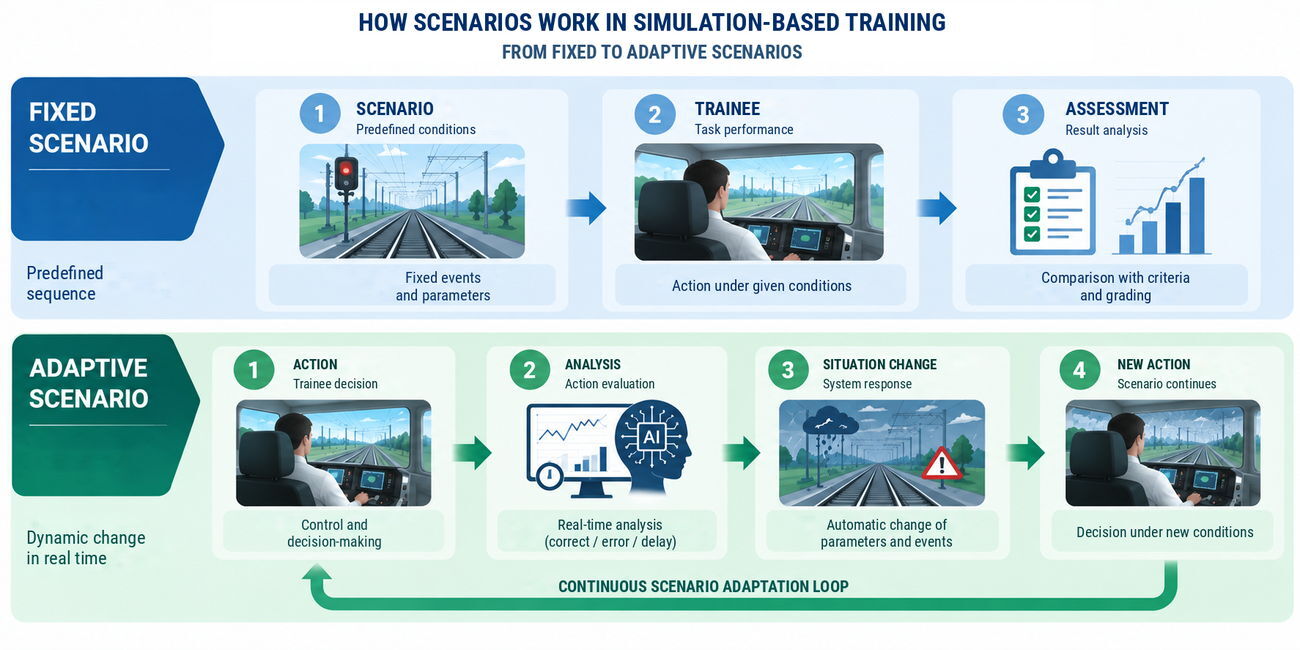
Thus, the scenario ceases to be merely a predefined sequence of events and becomes a dynamic part of the learning environment. The system begins to take into account not only which scenario was launched but also how the person acts while performing it.
This leads to the next important stage: the accumulation and analysis of data on trainee behavior. The decisions made, errors, reaction times, sequence of actions, and task outcomes may be recorded. These data make it possible to determine which elements of training cause the greatest difficulty and which skills require additional practice.
With a small number of scenarios, such analysis can be performed by an instructor or according to predefined rules. However, as the volume of data and the complexity of scenarios increase, there is a need for automated information processing and for automated selection of the system's subsequent actions.
It is at this stage that the application of artificial intelligence (AI) becomes possible. In such an architecture, AI neither replaces the instructor nor manages training independently. It can serve as an additional analytical layer that processes data on trainee actions, identifies stable patterns, and helps determine what the next task should be or how scenario parameters should be modified.
trainee action → data collection → analysis → identification of training needs → scenario modification → new action
This approach makes it possible to move from an identical sequence of tasks for all trainees to individualized and progressively adaptive training.
A further direction in the development of simulator technologies may be a closer link with the concept of digital twins. Unlike a conventional model, which is created to reproduce a typical object, a digital twin can be linked to a specific real object and take into account the data it supplies.
For railway transport, this means the possibility of moving from a generalized rolling stock model to a digital model of a specific technical system that reflects its parameters and operating characteristics (Figure 3). Such a model can be used not only for personnel training but also for analyzing technical condition, studying system behavior, and testing various scenarios without affecting the real object.
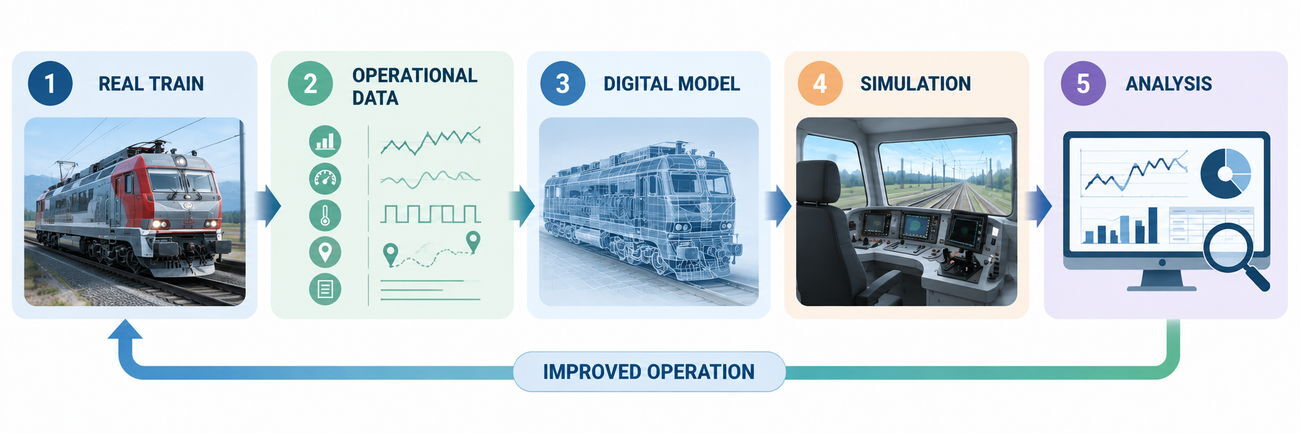
In the context of simulator technologies, this opens up the possibility of creating scenarios that correspond more closely to real operating conditions. For example, equipment performance data can be used to refine model parameters and to generate situations related to typical operating modes or to identified specific features.
Feedback is essential here. The results of modeling and analysis can be used to refine the digital model, modify training scenarios, assess personnel competencies, and formulate new research tasks. Thus, the digital twin becomes not merely a virtual copy of an object but a connecting element between real-world operations, modeling, and training.
The expansion of analytical capabilities changes the question posed to the simulator system. At the first level, the system answers the question: "How did the trainee perform?" The next level is: "What is the trainee likely to find difficult?" The prospective level is: "Where might a risk zone be emerging?"
This gives rise to the sequence reaction → analysis → prediction. Its implementation may combine operational data, simulator data, human factor information, analytical algorithms, and scenario modeling results.
An important feature of this approach is the shift in emphasis from responding to an already existing problem toward earlier identification of factors that require attention. However, risk forecasting should be regarded as a research direction that requires models to be evaluated against real operational data.
Thus, a simulator complex can potentially perform not only a training function but also an analytical one: identifying recurring training deficits, determining groups of scenarios of increased complexity, and generating proposals on priorities for further training.
Based on the directions discussed above, a prospective architecture can be outlined in which simulation becomes part of a closed loop linking real-world operations, personnel training, and risk management (Figure 4).
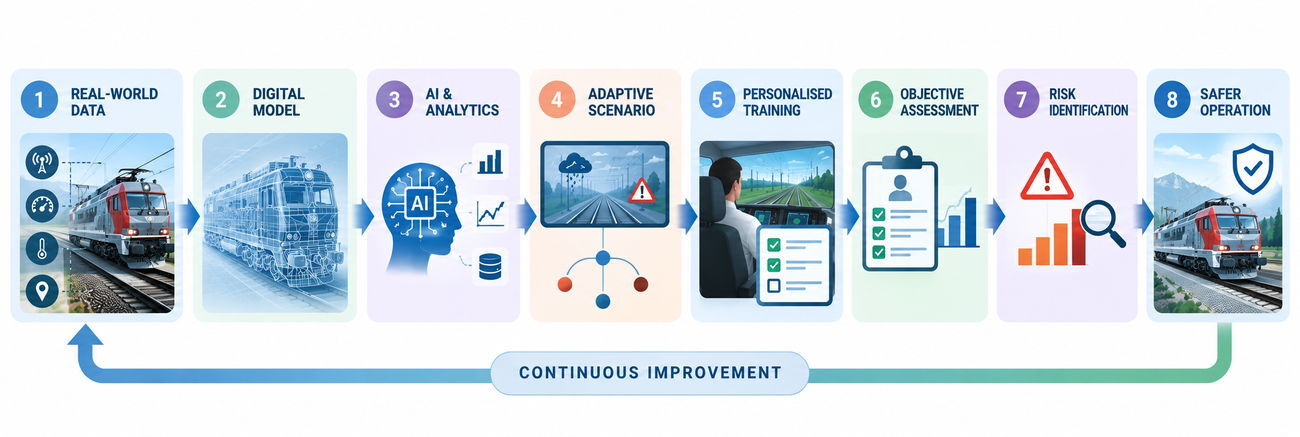
The primary source of information is real-world operational data. These data are used to improve digital models and to identify situations that require attention. The analytical layer processes this information together with the results of simulator training. On this basis, adaptive scenarios are generated or adjusted.
After a scenario is completed, the system receives new data on human actions and can assess the outcome objectively. Identified competency deficits are fed back into the training cycle, and the patterns obtained can be used to analyze potential risks. As a result, training ceases to be a finite procedure and becomes part of a continuous process.
Such an architecture does not imply abandoning the instructor or expert judgment altogether. On the contrary, automated analytics can be regarded as a tool that supports the specialist, making it possible to work with large volumes of data and to identify patterns that are difficult to detect when analyzing individual training sessions.
The proposed architecture is conceptual and should not be regarded as evidence that all of the functions listed have already been implemented in a single system. The degree of integration of simulator complexes with operational data, competency management systems, and safety management systems varies.
Moving from concept to practical implementation requires research in several areas: defining a set of significant indicators of trainee behavior; developing methods for matching simulator data with operational events; evaluating adaptive scenarios; assessing the reliability of forecasting algorithms; defining the role of expert judgment; and ensuring information security and the proper handling of data on the professional behavior of personnel.
A separate task is the development of standardized effectiveness criteria. In the long term, it will be necessary to evaluate not only the results of individual training sessions but also the durability of acquired skills, their transfer to real-world operations, and the impact of targeted training on safety performance indicators.
The development of railway simulation is gradually shifting from increasing the realism of individual simulators toward expanding their digital and analytical capabilities. A modern simulation environment can not only reproduce work situations but also record human actions, analyze results, and provide a basis for individualized training.
A promising next stage is the integration of real-world operational data, digital models, analytics, adaptive scenarios, and objective competency assessment. In such a system, simulation becomes an element of continuous feedback: operations generate data, data determine the content of training, training results make it possible to identify deficits and refine priorities, and the accumulated information is used to improve the safety system.
Thus, the simulator of the future should be viewed not as a copy of a locomotive cab but as a digital system that links the human, the technical model, data, and safety management processes.
The author declares no conflict of interest.
This research received no external funding.
No new empirical datasets were created within this conceptual article.
The manuscript underwent Double-Anonymous Peer Review by at least two independent subject-matter reviewers in accordance with the current editorial policy of IAE Review. The author is not affiliated with the journal's editorial office or publisher; the final publication decision was made by the editorial office.
13 references
Egzhanova, S. E. (2026). The evolution of railway simulation: from a virtual cab to an intelligent competency management system. IAE Review. IAE‑2026‑RSM‑001. https://iaexperts.com/en/journal/evolyutsiya-zheleznodorozhnoy-simulyatsii
About the author
Independent Researcher · specialist in simulator technologies, management in railway transport, and railway personnel training
A new approach to the data analyst profession: end-to-end ownership of analytical data flowsAleksandr Vasilchenko An AI-supported employee-driven performance management system: a conceptual model
 Tatiana Stetskaia
 Green building in residential development: principles, certification systems and economic rationale
 Vasilii Maslov
Journal
Submit your manuscript in Russian or English as DOCX, PDF or LaTeX through the submission form. Initial decision within 7 business days.
