
Expert witnesses
Failure analysis expert witness: how is a broken part examined, and when does the CPSC 24-hour reporting rule apply?
A failure analysis expert answers one question in a product case: why did this part break? Metallurgists and materials engineers read cracks, welds, heat treatment and alloy composition, and compare the failed unit with the drawings and with sound units. Courts test the method under Rule 702 and Kumho Tire. When the analysis is done inside the company, its findings can start the 24-hour clock for a report to the Consumer Product Safety Commission.
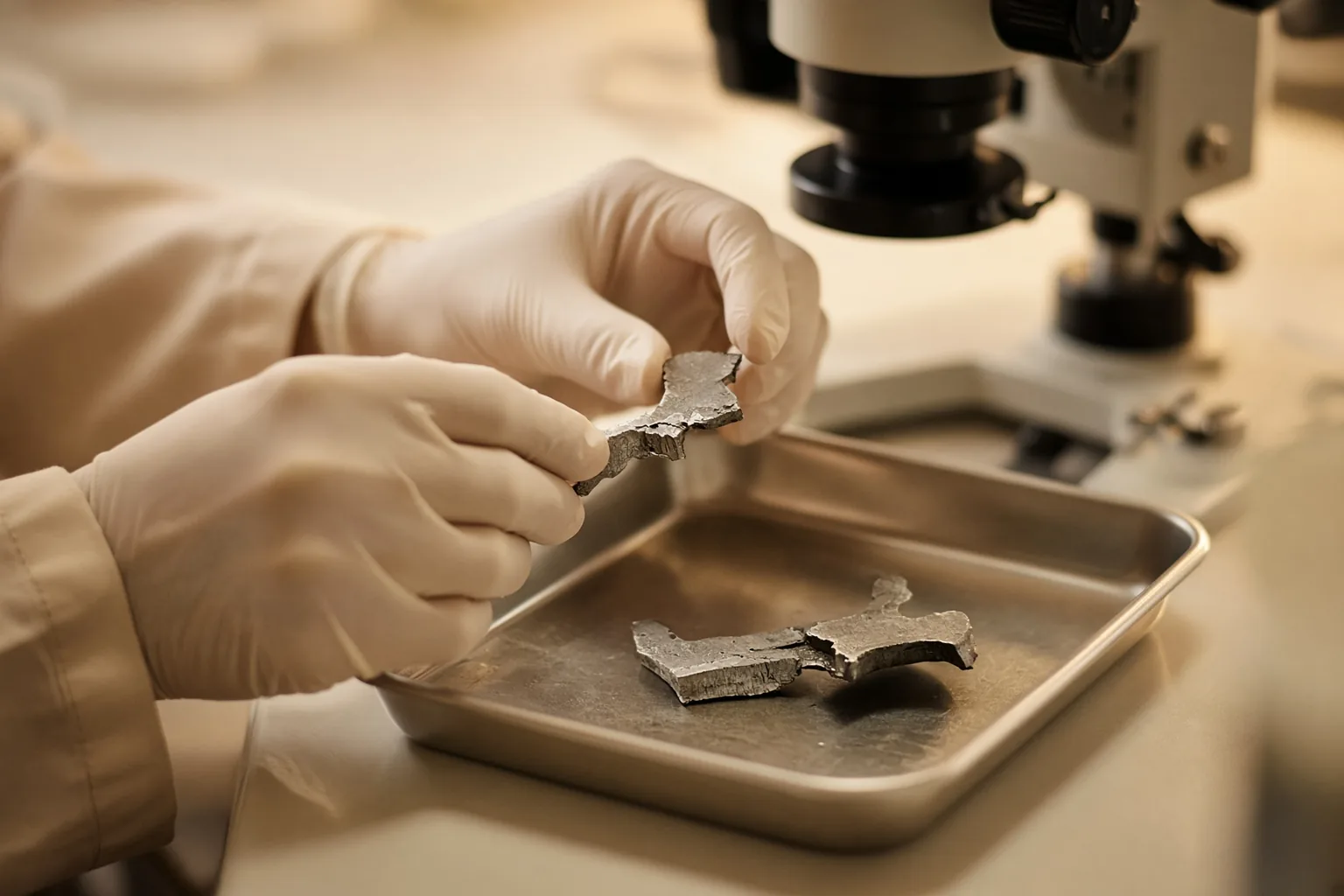
What does a failure analysis expert do in a product liability case?
The expert finds the physical cause of the failure: a crack, a weld, heat treatment, an alloy, a wire. The finding is then matched to a legal theory of defect: manufacture, design or warning.
IAE's product liability page groups these experts under part failure: metallurgists and materials engineers on cracks, welds, heat treatment and alloy composition, and electrical engineers on wiring and electronics failures. Their basic method is comparison. The failed unit is set against the manufacturer's drawings and against sound units of the same model.
The comparison maps onto state law. Under Ohio Revised Code 2307.74, a product is defective in manufacture or construction if, when it left the manufacturer's control, it deviated in a material way from the manufacturer's design specifications, formula or performance standards, or departed in a material way from otherwise identical units built on the same specifications. A measurement showing that the failed part's hardness or composition differs from the drawing, or from sound units of the same design, is evidence of that deviation.
The same statute adds that a product may be defective in manufacture "even though its manufacturer exercised all possible care in its manufacture or construction." In Ohio the expert does not have to show carelessness at the factory, only the deviation and its role in the failure.
Which legal theories does the expert's finding support?
In Ohio, four: defect in manufacture, defect in design or formulation, inadequate warning or instruction, and failure to conform to the manufacturer's representation. The claimant also proves that the defect was a proximate cause of the harm.
Ohio Revised Code 2307.73(A) requires the claimant to establish, by a preponderance of the evidence, that the product was defective in one of four ways described in sections 2307.74 through 2307.77, that the defect was a proximate cause of the harm, and that the manufacturer designed, formulated, produced, constructed, created, assembled or rebuilt the actual product that caused the harm.
A failure analysis can point to more than one theory. A unit that departs from its drawing or from identical units fits section 2307.74. A failure that the drawing itself produces in units made exactly to it is a question for section 2307.75, the design section. The expert's report states which of these the evidence fits and why other explanations were ruled out.
The last element of 2307.73(A) concerns identity: the manufacturer made the actual product. The failure analyst's documentation of part numbers, lot markings and date codes on the failed unit goes to that element.
What if the failed part was destroyed or lost?
Ohio permits the defect to be proved by circumstantial or other competent evidence when the product was destroyed and direct proof is impossible. The expert then works from photographs, records and exemplar units of the same model.
Under Ohio Revised Code 2307.73(B), if a claimant is unable to establish the defect by direct evidence because the manufacturer's product was destroyed, or is otherwise unable to do so, it is sufficient, consistent with the Rules of Evidence, to present circumstantial or other competent evidence that establishes, by a preponderance of the evidence, one of the four kinds of defect.
The statute does not lower the burden. It changes the kind of evidence the expert may use: photographs, records and testing of exemplar units of the same model. The expert's report then explains why the exemplars are comparable to the destroyed unit.
How does the expert get access to a product held by the other side?
Through a request under Rule 34 of the Federal Rules of Civil Procedure to inspect, test or sample a tangible thing. The request names a reasonable time, place and manner, and the written response is due within 30 days.
Rule 34(a)(1)(B) lets a party ask another party to produce designated tangible things so that the requesting party may inspect, copy, test or sample them. The request "must specify a reasonable time, place, and manner for the inspection and for performing the related acts" (Rule 34(b)(1)(B)), and the party served "must respond in writing within 30 days after being served" (Rule 34(b)(2)(A)).
Products in the hands of a nonparty, such as a repair shop, an insurer or a salvage yard, are reached by subpoena: "As provided in Rule 45, a nonparty may be compelled to produce documents and tangible things or to permit an inspection" (Rule 34(c)).
Testing and sampling were added to the rule in 1970. The committee note explains that the rule added testing and sampling of tangible things because parties frequently need them in preparation for trial. For a failure analyst, the manner of the inspection named in the request is the protocol: who handles the part, which tests are run, and in what order.
Can the expert cut or test the part to destruction?
ASTM E860-22 governs that step. It applies when examination or testing is likely to change the nature, state or condition of the evidence, and it describes specific actions required for destructive testing.
ASTM E860-22, the Standard Practice for Examining and Preparing Items That Are or May Become Involved in Criminal or Civil Litigation, is listed by ASTM as an active standard of Committee E30, subcommittee E30.11. Section 1.1 covers the examination and testing of evidence items or systems "that may have been involved in a specific incident" and are, or may reasonably be expected to be, the subject of civil or criminal litigation.
Under section 1.2, the practice applies when examination or testing of evidence is required "and such examination is likely to change the nature, state, or condition of the evidence." Section 4.1 says that it establishes procedures for the forensic science practitioner to document the nature, state or condition of items of evidence, and that it "describes specific actions that are required for destructive testing" when planned testing, examination or disassembly is likely to alter the evidence so as to preclude or adversely limit additional examination or testing.
Under section 4.2, deviations from the practice "are not necessarily wrong or inferior," but they should be justified and documented. Section 1.3 states that the practice is intended for competent forensic science practitioners with formal education, discipline-specific training and proven proficiency in forensic casework.
How do courts test a failure analyst's method?
Under the gatekeeping duty that Kumho Tire Co. v. Carmichael (1999) extended to all expert testimony. In that case the Supreme Court upheld the exclusion of a tire failure analyst whose visual and tactile inspection method was found unreliable.
On July 6, 1993, the right rear tire of a minivan driven by Patrick Carmichael failed; one passenger died and others were severely injured. The tire was made in 1988. The tread, 11/32 of an inch deep when new, had worn to between 3/32 of an inch and nothing, and it had at least two inadequately repaired punctures. The plaintiffs' expert, Dennis Carlson, held a master's degree in mechanical engineering and had worked about 10 years at Michelin America.
Carlson relied on visual and tactile inspection. He looked for four physical signs of tire abuse (overdeflection): greater wear on the shoulder than in the center, grooves along the bead, sidewall discoloration and marks from the rim flange. If he did not find at least two of the four signs, he concluded that a manufacturing or design defect caused the separation. The District Court excluded his testimony; the Eleventh Circuit reversed, reasoning that Daubert covered only scientific testimony.
On March 23, 1999, the Supreme Court reversed the Eleventh Circuit in an opinion by Justice Breyer. The gatekeeping obligation applies to testimony based on technical and other specialized knowledge. The Daubert factors (testing, peer review, error rates, standards and general acceptance) may be used where they help, the test is flexible, and the trial court's choices are reviewed for abuse of discretion. The goal is that an expert "employs in the courtroom the same level of intellectual rigor that characterizes the practice of an expert in the relevant field."
Where does Rule 702 limit a failure analyst's opinion?
Each opinion must stay within what a reliable application of the expert's basis and method supports. Since December 1, 2023, the proponent must show the court that this is more likely than not.
Rule 702 of the Federal Rules of Evidence, as amended on December 1, 2023, admits expert testimony if the proponent shows the court "that it is more likely than not" that the four conditions are met. The committee note calls this "the preponderance of the evidence standard that applies to most of the admissibility requirements."
The note adds that "each expert opinion must stay within the bounds of what can be concluded from a reliable application" of the expert's basis and methodology. For a failure analyst, a fractograph can support an opinion on where and how a crack began. An opinion on what the manufacturer knew, or on whether the product was unreasonably dangerous, needs its own basis.
State courts apply their own rules on expert admissibility and on proof of defect. The analyst's report is written for the rules of the court where the case is pending.
When must a manufacturer report a product defect to the CPSC?
Immediately after it obtains information that reasonably supports the conclusion that a consumer product has a defect that could create a substantial product hazard, fails a safety rule, or creates an unreasonable risk of serious injury or death.
Section 15(b) of the Consumer Product Safety Act, 15 U.S.C. 2064(b), applies to manufacturers of consumer products and to their distributors and retailers. A firm that "obtains information which reasonably supports the conclusion that such product" fails to comply with an applicable rule, contains a defect that could create a substantial product hazard, or creates an unreasonable risk of serious injury or death "shall immediately inform the Commission." No report is needed if the firm has actual knowledge that the Commission has been adequately informed.
Subsection (a)(2) defines one kind of substantial product hazard as a product defect that, because of the pattern of defects, the number of defective products, the severity of the risk or otherwise, creates a substantial risk of injury to the public.
The terms of that definition are the terms of a failure analysis: a pattern across units, the number of units affected and the severity of the failure.
What do the 24-hour and 10-day rules mean?
Under 16 CFR 1115.14, a firm reports within 24 hours after obtaining reportable information. To evaluate reportability it may investigate, for no more than 10 days unless it can justify a longer period.
16 CFR 1115.14(e) reads "immediately" as within 24 hours after a firm has obtained information that reasonably supports the conclusion of a noncompliance, a substantial product hazard or an unreasonable risk of serious injury or death. Under paragraph (a), weekends and holidays are excluded from the time periods.
Paragraph (d) permits a reasonably expeditious investigation to decide whether a death, a grievous bodily injury or other information must be reported. The investigation should not exceed 10 days unless a firm can show that a longer period is reasonable. After 10 days, the Commission assumes that the firm has considered all the information a diligent investigation would have uncovered.
Paragraph (b) imputes to the firm the knowledge of an employee who can appreciate the significance of the information, and sets 5 days, under ordinary circumstances, as the maximum reasonable time for that information to reach the chief executive officer or the official responsible for section 15(b) reports.
Does an internal failure analysis start the reporting clock?
It can. The reporting obligation may arise with the first information, including engineering and quality control data, and if the firm investigates, the 24-hour period starts as soon as the investigation produces reportable information.
Under 16 CFR 1115.14(c), the obligation may arise when the firm first receives information about a noncompliance, a potential hazard from a defect or an unreasonable risk. That information can include complaints, injury reports, quality control data and engineering data, and "A subject firm should not await complete or accurate risk estimates."
Paragraph (e) covers the firm that decides to look first: "If a firm elects to conduct an investigation in order to evaluate the existence of reportable information," the 24-hour period begins once the firm has information that reasonably supports the conclusion during the investigation. The firm may therefore have to report before the investigation ends, or it may skip the investigation and report at once.
Under paragraphs (b), (d) and (e), three dates count: when the information reached an employee able to appreciate its significance, when it reached the chief executive officer or the official responsible for reports, and when the investigation produced information that reasonably supports the conclusion. The test log, the laboratory records and the internal correspondence carry those dates.
What can the CPSC order after a substantial product hazard is found?
After a hearing, the Commission may order public notice and the stop of distribution, and the repair, replacement or refund of the product. Under subsection (e), consumers are not charged for these remedies.
Under 15 U.S.C. 2064(c), after a hearing the Commission may order the manufacturer, a distributor or a retailer to stop distribution, to notify the persons who handle the product and state and local health officials, and to give public notice, including online and, where needed, in other languages or through broadcast media.
Under subsection (d), after a hearing and if the action is in the public interest, the Commission may order the firm to bring the product into compliance or repair the defect, to replace it with a like or equivalent product, or to refund the purchase price, less a reasonable allowance for use if the consumer has had the product for one year or more. The firm submits an action plan for the Commission's approval. Under subsection (e)(1), no charge is made to a person other than a manufacturer, distributor or retailer who uses the remedy, and the firm reimburses that person's reasonable and foreseeable expenses.
How does IAE find a failure analysis expert for a product case?
In the request choose the case type Product liability and name the product, the failed part and the defect theory. Within 5 business days IAE sends 2-3 candidates with CVs, hourly rates and lists of prior testimony.
The product liability expert witness page lists 8 specialties, among them failure analysis, materials science and electrical engineering. Its "Part failure" group names metallurgists and materials engineers on cracks, welds, heat treatment and alloy composition, and electrical engineers on wiring and electronics failures, with comparison against drawings and sound units.
The request form asks for the field, the case type, the state and court, the firm's side, the expert disclosure deadline and the parties with their counsel. In the short description, name the product and model, the failed part, where the part is held now and whether it has been tested, and the defect theory: manufacture, design or warning. The form asks not to include privileged or sealed information.
Within 1 business day IAE replies whether it can search in that field by the deadline. Each candidate confirms in writing that he or she has no ties to the parties or their counsel. Within 5 business days the firm receives 2-3 candidates with CVs, hourly rates, testimony in the last 4 years and publications in the last 10 years. Candidate names and CVs come after the $2,000 search fee is paid in advance. If no candidate fits, the second search is free, and if IAE finds no candidates, it refunds the fee.
The expert bills the firm directly or through IAE under the agency option at +$100 per hour, which credits the search fee to the first invoice. The expert's hourly rate never depends on the outcome of the case or on the content of testimony. IAE is not a law firm. Case strategy and the decision to retain an expert stay with the attorney.
Sources
- Ohio Revised Code 2307.74, Product defective in manufacture or construction
- Ohio Revised Code 2307.73, Liability of manufacturer; proof of defect
- Federal Rules of Civil Procedure, Rule 34, Producing Documents, Electronically Stored Information, and Tangible Things, with committee notes (LII, Cornell Law School)
- ASTM E860-22, Standard Practice for Examining and Preparing Items That Are or May Become Involved in Criminal or Civil Litigation (ASTM International)
- Kumho Tire Co. v. Carmichael, 526 U.S. 137 (1999), opinion of the Court (LII, Cornell Law School)
- Federal Rules of Evidence, Rule 702, Testimony by Expert Witnesses, with committee notes (United States Code, 2023 edition, govinfo)
- 15 U.S.C. 2064, Substantial product hazards (LII, Cornell Law School)
- 16 CFR 1115.14, Time computations (LII, Cornell Law School)
Read also
All articles

State of the art defense in product liability: what must the manufacturer's expert prove about the technology available when the product was made?
The state of the art defense asks what a manufacturer could have known and built on the day the product left its hands, not on the day of the injury Sergei Voronin

Toy injury expert witness: small parts, age grading and ASTM F963 in a children's product case
A toy injury case usually turns on a short list of questions: was the toy meant for a child under three, did any part fit inside the federal smallSergei Voronin
Machine guarding expert witness: what does the engineer examine when a worker is hurt by an unguarded machine?
When a worker is hurt at the point of operation of a machine, the case usually turns on the guard: how the machine was designed to keep hands outSergei VoroninExpert witnesses
Need an expert witness for your case?
Describe the question, the case type and the court. Within 5 business days you receive 2-3 candidates with CVs, hourly rates and lists of prior testimony.
